
← Statistics and Probability from Scratch
Lesson
Lesson 2: The Central Limit Theorem and standard error
Explain the Central Limit Theorem and calculate the standard error of the mean SE=SD/√n.
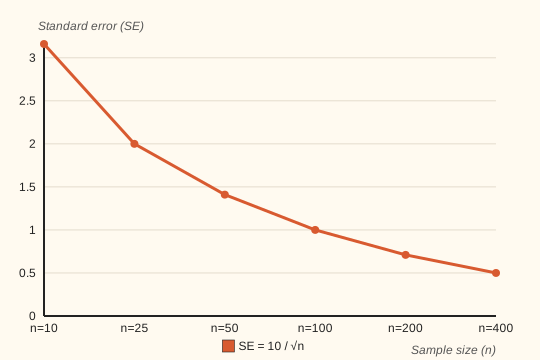
The standard error shrinks as the sample grows
SE = SD / √n with SD = 10
The Central Limit Theorem guarantees: the larger the sample, the more precise the estimate of the mean. SE shrinks with the square root of n.
Lesson notes
The CLT and the standard error of the mean
The Central Limit Theorem (CLT) is one of the most important results in statistics. In short: if you take repeated random samples of size n from any distribution (with a finite mean and variance), then for large enough n the sampling distribution of the sample mean approaches a normal distribution. This holds even when the original data are far from normal — skewed or with several peaks. In practice, n ≥ 30 is usually considered “large enough.”
The standard error of the mean (SE) shows how far the sample mean deviates from the true population mean. Formula: SE = SD / √n, where SD is the population standard deviation (or its estimate from the sample) and n is the sample size.
Example: SD = 20, n = 100 → SE = 20 / √100 = 20 / 10 = 2. If you increase the sample to n = 400: SE = 20 / √400 = 20 / 20 = 1. Conclusion: the larger the sample, the smaller the standard error and the more precise the estimate of the mean. Making the sample 4 times larger cuts SE in half — precision grows slowly, with the square root of n.