
The learner can analyze stakeholders on an influence × interest grid and capture responsibility with a RACI matrix that has exactly one Accountable per task.
The Influence × Interest grid
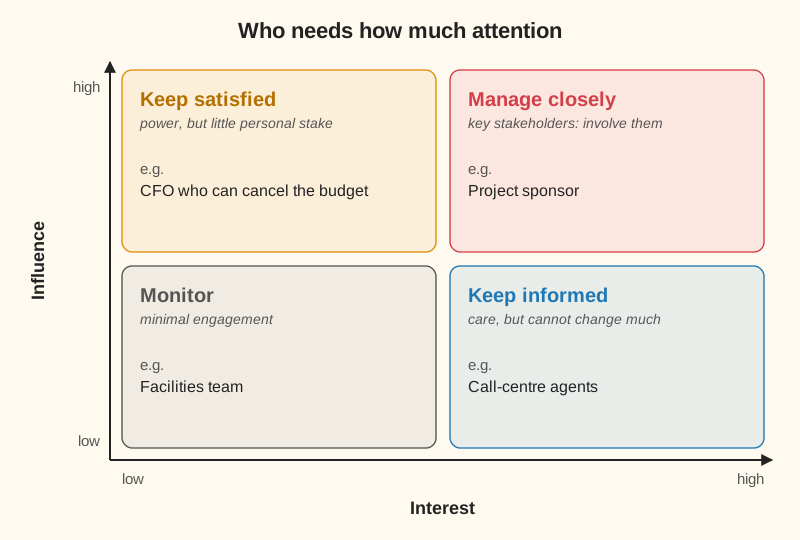
Who needs how much attention
Place each stakeholder in one of four boxes; the box tells you how to engage them.
Lesson notes
Influence × Interest grid and RACI matrix
Stakeholder analysis starts with identifying everyone who is affected by or can affect the project, then understanding their power over the project and their stake in its outcome. Look beyond the obvious client and users: indirect stakeholders — regulators, the IT and security teams, neighboring departments, your customers' customers — are the ones most often missed. The Influence × Interest grid (sometimes called the Power/Interest matrix) maps stakeholders on two axes and prescribes an engagement strategy for each quadrant.
High influence, high interest — Manage closely. These are your key stakeholders: they care deeply and have the power to make or break the project. Engage them frequently and keep them involved in decisions. High influence, low interest — Keep satisfied. They have power but aren't personally invested; neglect them and they can become blockers. Low influence, high interest — Keep informed. They care about the outcome but cannot directly affect the project; regular updates prevent frustration. Low influence, low interest — Monitor. Minimal engagement is sufficient; over-communicating wastes everyone's time.
RACI: who does what — and one Accountable
A RACI matrix documents who does what for each task or decision. Each letter stands for: Responsible — the person (or people) who actually do the work; every task needs at least one R, and the Accountable person may also be the R. Accountable — the single person who owns the outcome and has the final say; they delegate to the Responsible party. Consulted — people whose input is sought before a decision is made (two-way communication). Informed — people who are told about progress or decisions after the fact (one-way communication).
The golden rule: exactly ONE Accountable per task. Shared accountability effectively disappears — if everyone is accountable, no one is. This is one of the most common anti-patterns in project governance. Incomplete stakeholder analysis — missing a key stakeholder entirely — is equally dangerous: a powerful person who was never engaged can derail a project late in delivery when changes are expensive.