
Separate fixed and variable costs and calculate the contribution margin and contribution margin ratio with the formula (price − variable cost per unit).
How fixed and variable costs behave as volume grows
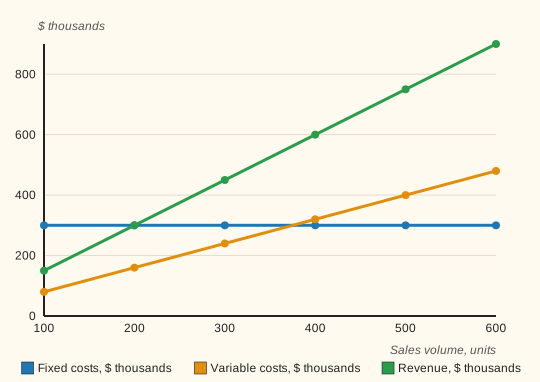
Fixed costs don't change; variable costs grow with sales
Understanding the cost structure helps you forecast how profit will change when revenue rises or falls.
Lesson notes
Fixed costs, variable costs, and margin
All business costs can be divided into two types. Fixed costs don't depend on production or sales volume: office rent, staff salaries, software subscriptions. You pay them every month no matter how many units you sell — 100 or 10,000. Variable costs, by contrast, grow in proportion to volume: raw materials, sales commissions, delivery costs for each unit.
The contribution margin per unit is the difference between the selling price and the variable cost of one unit: Margin per unit = Price − Variable cost per unit. If you sell a product for $1,000 and the variable costs are $600, the margin per unit is $400. Contribution margin ratio (margin as a percentage) = Margin per unit / Price = 400 / 1,000 = 40%.
Why separate costs? First, it lets you calculate the break-even point: the sales volume at which the total margin covers all fixed costs. Second, it helps you understand scaling: if you double sales, fixed costs stay the same while the total margin doubles — and profit grows disproportionately.
In a financial model, each cost item is a separate row. Fixed and variable costs are kept in separate blocks, and their formulas reference assumption cells instead of containing hardcoded numbers.