
Apply the addition rule P(A or B)=P(A)+P(B)−P(A and B), correctly accounting for the intersection of the events.
The addition rule: two cases
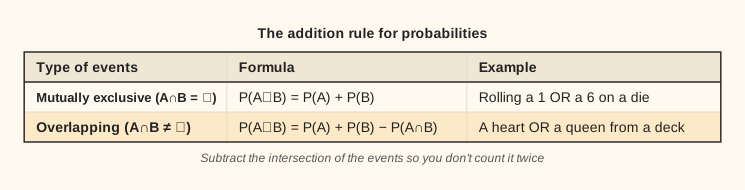
Formulas for overlapping and mutually exclusive events
The addition formula depends on whether events A and B can happen at the same time.
Lesson notes
The addition rule for probabilities
When we want to know whether at least one of two events, A or B, happens, we use the addition rule: P(A or B) = P(A) + P(B) − P(A and B). Subtracting P(A and B) is necessary because outcomes that belong to both events would otherwise be counted twice.
Consider a die. Event A = “an even number comes up” = {2, 4, 6}, P(A) = 3/6. Event B = “a number greater than 4 comes up” = {5, 6}, P(B) = 2/6. The intersection of A and B = {6}, P(A and B) = 1/6. Then P(A or B) = 3/6 + 2/6 − 1/6 = 4/6 = 2/3.
If the events are mutually exclusive — they can't happen at the same time, that is, A and B don't overlap — then P(A and B) = 0, and the formula simplifies to P(A or B) = P(A) + P(B). For example, on a die, the events “Rolled a 1” and “Rolled a 6” are mutually exclusive: they can't both happen on one roll.
A common mistake is to simply add P(A) + P(B) and forget to subtract the intersection. The result is an inflated probability, sometimes even greater than 1, which is impossible.