
Understand the place of slavery in the Roman economy and figure out the basics of how money was counted and spent.
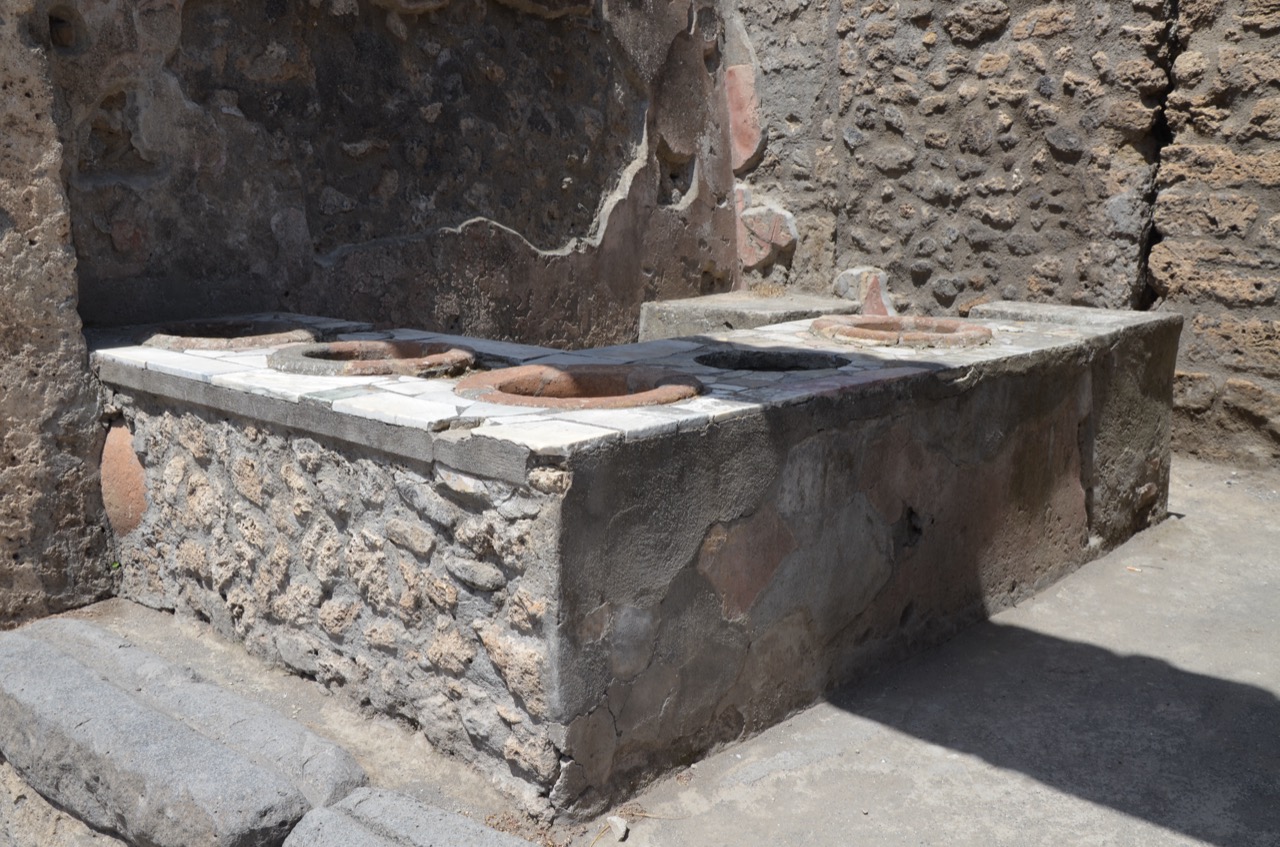
The thermopolium: Roman “fast food”
Where city dwellers ate on the go
The marble counter of a thermopolium with built-in dolia, jars in which food and drinks may have been kept.
Lesson notes
Slavery: the cruel foundation of the economy
You can't understand Rome without being honest about slavery. Slaves were everywhere and did a huge share of all the work: they labored in fields and mines, served in houses, worked in workshops, taught children, kept accounts, and copied books. A slave was considered not a person but “property,” a thing owned by his master — it was a cruel system.
But Roman slavery had one peculiarity: there was a way out. A master could set a slave free — this was called manumission. The freed slave became a freedman and gained many of the rights of a citizen (though not all). Some freedmen grew rich and started their own businesses; their children were already fully free Romans.
The lives of slaves varied enormously. A slave steward or an educated secretary in a rich household lived incomparably better than a worn-out laborer in a mine or a quarry. But both always lived under the master's absolute power.
How money was counted
Roman money meant metal coins. The main silver coin was the denarius; small payments were made in sesterces and copper as coins (a denarius was worth four sesterces). Large sums and fortunes were usually stated in sesterces. The gold coin (the aureus) came into play for very large payments.
To get a sense of scale: a plain bread roll or a mug of cheap wine at a tavern cost a few as coins — literally pennies. A simple laborer's daily earnings or a soldier's pay came to a few sesterces a day. A senator's wealth, on the other hand, was counted in millions of sesterces — the gap between rich and poor was enormous.
There were no “bills” in our sense — only hard coin. But there were money changers, receipts, and IOUs: the trade of a great empire required credit and trust, not just a bag of coins.