
The learner can read a simple BPMN diagram described in words and arrange the steps of a process into a correct, consistent order with proper branching.
The expense-approval process as a diagram
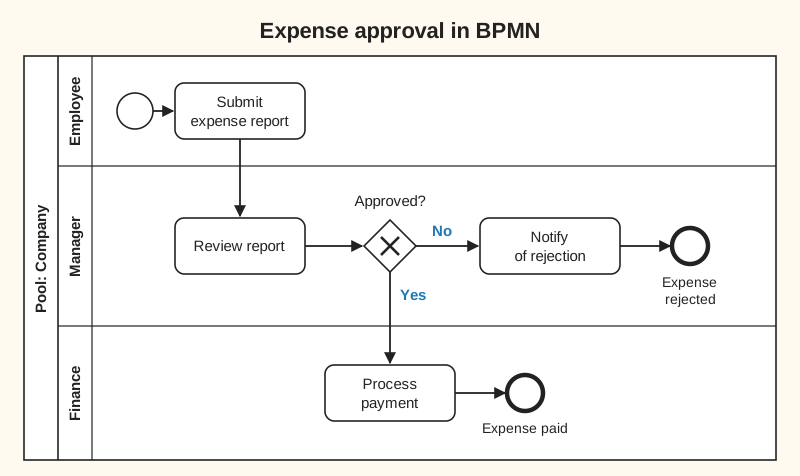
Expense approval in BPMN
This is the process described in the theory, drawn the way you would see it in a real model: three lanes, one decision, two endings.
Lesson notes
How to read a BPMN flow
Reading a BPMN diagram always starts at the Start Event (the thin-bordered circle) and follows the solid arrows — Sequence Flows — from element to element until the End Event (thick-bordered circle) is reached. Every path through the diagram must eventually reach an End Event; a path that leads nowhere is a modeling error (BPMN tools may accept it, but good-practice style rules require explicit End Events).
When you reach a Gateway (diamond), you apply its rule. For an Exclusive (XOR) Gateway, you evaluate the conditions on each outgoing arrow and follow exactly one path. The chosen path continues until it either reaches an End Event or merges back into the main flow, typically through another Gateway drawn as a diamond.
Consider a simple expense-approval process: the process starts → the employee submits an expense report (Task) → a manager reviews it (Task) → an Exclusive Gateway checks 'Is it approved?' → if Yes, finance processes the payment (Task) → End Event; if No, the employee is notified of rejection (Task) → End Event. Notice that both branches — Yes and No — lead to their own End Event. Every branch must be closed.
When you build or check a process model, ask three questions: (1) Does every path start from a Start Event? (2) Does every path end at an End Event? (3) Does every Gateway have a clear condition on each outgoing arrow so the rule for choosing a path is unambiguous?