
Understand that yeast is alive and learn to control it through temperature and time, without killing it or overproofing the dough.
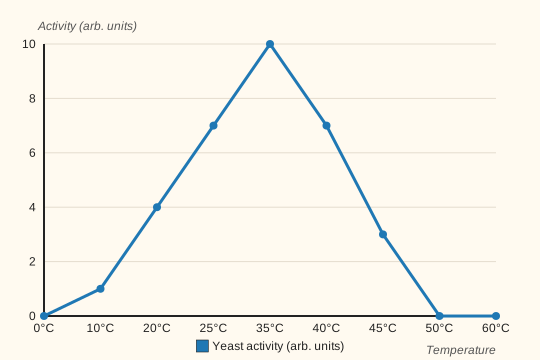
Yeast activity vs. temperature
The sweet spot: 25–35 °C
Yeast is a living organism: too cold and it goes dormant, too hot and it dies. For dough to rise, keep the temperature “comfortable.”
Lesson notes
Warmth, time, and food for yeast
Since yeast is alive, you have to treat it like something alive. It has a comfortable temperature, an appetite, and it gets tired.
Temperature. When it's warm (about 25–35 °C), yeast is active and dough rises faster. In the cold it nearly goes dormant — so you can slow dough down in the fridge and let it rise overnight (many bakers do this: a slow rise gives a deeper flavor). Heat, however, kills it: yeast dies above roughly 50–60 °C. That's why the liquid for the dough should be warm but not hot — hot water will “cook” the yeast, and the dough won't rise.
Food. Yeast needs sugars. There are enough in the flour itself (starch gradually turns into sugars), but a pinch of sugar can speed up the start. Too much salt, on the other hand, inhibits yeast, which is why salt usually isn't poured right onto the yeast.
Time and fatigue. The dough needs to rise — usually to about double its size. But if you leave it too long, it “overproofs”: the gluten framework weakens, the dough collapses, and a sharp sour, boozy smell appears. Then the bread comes out flat. The principle: go by the state of the dough, not strictly by the minutes in the recipe (doubled in size, elastic, slowly springing back when you press it with a finger).