
Apply the binomial distribution to find the probability of k successes in n independent trials with probability p.
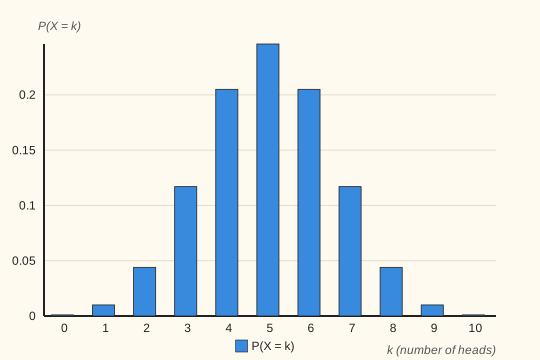
Binomial distribution B(10, 0.5)
Probabilities for the number of heads in 10 coin tosses
With n = 10 independent coin tosses and p = 0.5, 4–6 heads are the most likely. The distribution is symmetric around μ = np = 5.
Lesson notes
The binomial distribution
The binomial setting arises when: (1) exactly n independent trials are carried out; (2) each trial has two outcomes — “success” and “failure”; (3) the probability of success p is the same in every trial. The number of successes X in this setting has a binomial distribution.
Formula: P(X = k) = C(n, k) · p^k · (1 − p)^(n − k), where C(n, k) = n! / (k! · (n − k)!) is the number of combinations (we met them in Unit 3). Here k is the desired number of successes, p^k is the probability of k successes in a row, (1−p)^(n−k) is the probability of the remaining (n−k) failures, and C(n,k) counts how many ways the k successes can be placed among the n trials.
Example: toss a coin 3 times, p = 0.5. What is the probability of exactly 2 heads? k = 2, n = 3. C(3, 2) = 3. P(X = 2) = 3 · 0.5² · 0.5¹ = 3 · 0.25 · 0.5 = 3 · 0.125 = 0.375 = 3/8. So about 37.5% of the time you get exactly 2 heads.
Example 2: the probability that a website visitor clicks a button is 0.3. Out of 4 visitors, what is the probability of exactly 1 click? C(4,1) = 4, P = 4 · 0.3¹ · 0.7³ = 4 · 0.3 · 0.343 = 0.4116 ≈ 41.2%.