
Understand what an emulsion is and why you need an emulsifier to combine oil and water, which don't mix on their own.
Types of emulsions in cooking
Oil-in-water or water-in-oil?
An emulsion is a mixture of two liquids that don't mix: oil and water. Without an emulsifier, they quickly separate. The type of emulsion determines a sauce's texture.
Lesson notes
Why oil and water don't mix
Pour oil into water — it floats to the top and won't mix, however much you stir: a minute later the layers separate again. Oil and water “don't get along” at the molecular level. Yet mayonnaise, salad dressing, and hollandaise are exactly that: oil evenly combined with a watery base. How?
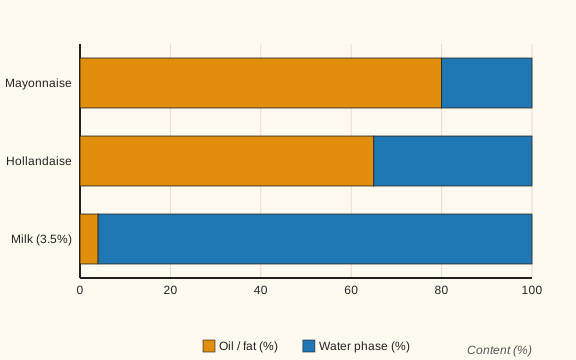
Such a mixture is called an emulsion — a multitude of tiny droplets of one liquid suspended in another. In mayonnaise, these are tiny droplets of oil surrounded by water. To keep the droplets from merging back into a layer of oil, you need a go-between — an emulsifier.
An emulsifier is a substance with one part that “likes” water and another that “likes” oil. It surrounds each oil droplet and keeps the droplets from merging, holding them apart in the water. The best kitchen emulsifier is egg yolk (it contains lecithin). Mustard, honey, and to some extent proteins and starches themselves also work as emulsifiers.
To make an emulsion, mixing isn't enough — you have to break the oil into tiny droplets mechanically: whisk hard or add the oil in a very thin stream while stirring constantly. Then the emulsifier has time to “wrap” each new droplet. The principle: emulsion = tiny droplets + emulsifier + mechanical work. Remove any one of them, and the sauce separates.