
← Statistics and Probability from Scratch
Lesson
Lesson 3: Counting — arrangements, permutations, combinations
Calculate arrangements, permutations, and combinations, and choose the formula by asking “does order matter?”
Counting formulas
Arrangements, permutations, and combinations: when to use which
The key question: does order matter? The answer determines which of the three formulas to use.
Lesson notes
Arrangements, permutations, and combinations
Counting answers the question: how many ways are there to choose or arrange objects? The main question when choosing a formula: does order matter?
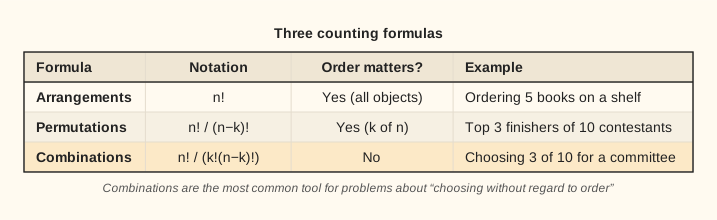
The multiplication rule: if there are n₁ options at the first step, n₂ at the second, and so on, then there are n₁ · n₂ · ... options in total. Arrangements are the number of ways to put all n objects in a row: n! = n · (n−1) · ... · 1. For example, 5! = 5·4·3·2·1 = 120.
Permutations P(n,k): choose k objects out of n, and order matters: P(n,k) = n! / (n−k)!. Example: P(5,2) = 5!/(5−2)! = 120/6 = 20. This answers the question “in how many ways can you choose 2 of 5 people and put them in first and second place?”
Combinations C(n,k): choose k objects out of n, and order does NOT matter: C(n,k) = n! / (k! · (n−k)!). Example: C(5,2) = 120 / (2 · 6) = 120/12 = 10. This answers “in how many ways can you choose a team of 2 out of 5 people, regardless of order?” Note: C(5,2) = 10 = P(5,2)/2! = 20/2. The number of combinations is always less than or equal to the number of permutations.