
Understand that dough rises because of gas bubbles held in a framework, and tell apart three ways to produce them: yeast, baking soda, and baking powder.
Baking soda reacting with acid
Where the carbon dioxide in baked goods comes from
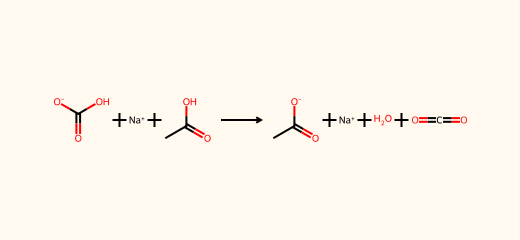
When baking soda (sodium bicarbonate) meets an acid — for example, buttermilk or lemon juice — it releases CO₂. These are the bubbles that make dough rise.
Lesson notes
Where the holes in baked goods come from
All fluffy baked goods rise for one reason: gas bubbles form inside the dough, and a framework (gluten or an egg/starch structure) holds them until the bake sets. There are three main ways to get the gas.
The first is yeast: living microorganisms (fungi). Yeast eats sugars and gives off carbon dioxide (and a little alcohol). It's a slow, biological rise: the dough needs time to “rise” somewhere warm. Yeast also gives bread its typical flavor and aroma. Too much heat kills yeast (it dies above roughly 50–60 °C); too much cold slows it down.
The second is baking soda. This is chemistry, not life. Baking soda gives off carbon dioxide when it meets an acid (buttermilk, lemon juice, vinegar, cocoa). The reaction starts as soon as you mix, so a baking soda batter must go into the oven fast, before the gas is wasted. Without acid, baking soda won't work properly and can leave a soapy aftertaste.
The third is baking powder. It's essentially baking soda with a dry acid already added, so it doesn't need an acidic ingredient in the recipe: moisture and heat are enough to set off the gas. Handy when the dough has no acidic ingredients.
The principle: gas creates the rise, and the framework holds it. So you need both a lift (yeast/baking soda/baking powder) and something to hold the bubbles (gluten, eggs).