
The learner can recognize and correctly name the basic BPMN elements: events (circles), tasks (rounded rectangles), gateways (diamonds), sequence flows (arrows), and swimlanes (who performs).
BPMN core shapes at a glance
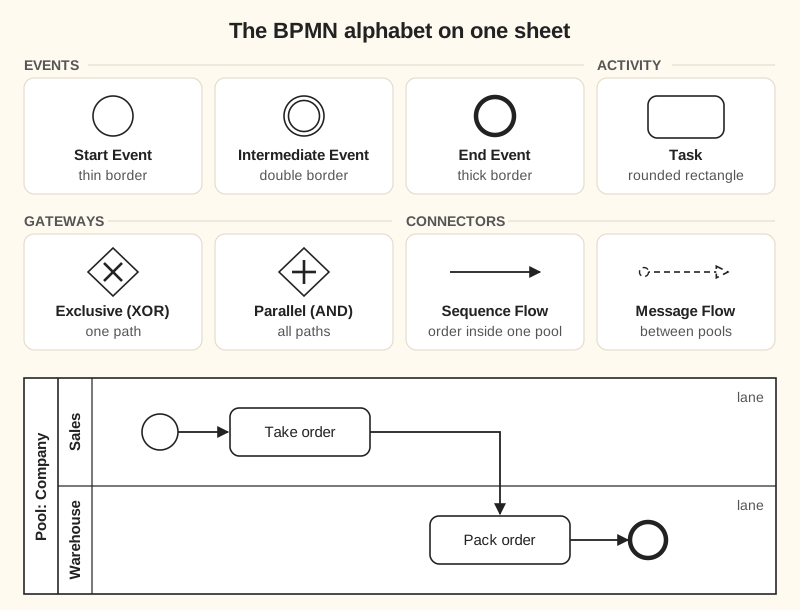
The BPMN alphabet on one sheet
Every BPMN diagram is built from a handful of shapes. Look at them before reading the theory — you will meet each one in the exercises.
Lesson notes
The core shapes of BPMN 2.0
BPMN (Business Process Model and Notation) is a standardized visual language for drawing business processes. Every BPMN diagram is built from a small set of shapes, each with a fixed meaning — so anyone trained in BPMN can read a diagram drawn by someone else anywhere in the world.
The five most fundamental elements are: Events, Tasks, Gateways, Sequence Flows, and Swimlanes. An Event marks something that happens — it is drawn as a circle. A Start Event (a thin-bordered circle) launches the process; an End Event (a thick-bordered circle) marks where the process finishes. A Task or Activity represents a unit of work someone or some system performs — it is drawn as a rounded rectangle with a label inside.
A Gateway controls how the flow splits or merges — it is drawn as a diamond. The most common type is the Exclusive Gateway (XOR), which means exactly one of the outgoing paths is taken depending on a condition. You will also often meet the Parallel Gateway (a diamond with a '+'): it starts ALL outgoing paths at once, and a second '+' gateway waits until all of them are finished. A circle with a double border is an intermediate event — something that happens in the middle of the process, such as 'wait 2 days' or 'payment received'. A Sequence Flow is the solid arrow that connects elements and shows the order of execution.
Who does the work: pools, lanes and message flows
Finally, Swimlanes organize who performs the work. A Pool represents an entire participant (for example, a company or a system). Inside a Pool, Lanes divide the work between roles or departments — every element placed in a lane belongs to that role. Swimlanes are optional: a simple diagram for a single participant may show no pools or lanes at all. Sequence Flows connect elements only INSIDE one Pool. When two Pools communicate — a customer sends an order to a shop — you draw a Message Flow: a dashed arrow with a small open circle at its start, running between the Pools.