
← Financial Modeling in Excel from Scratch
Lesson
Discounting, the discount rate (WACC), and terminal value
Assemble a DCF valuation from its parts: discount the forecast cash flows at a rate (conceptually, WACC) and add the terminal value.
DCF valuation: three essential blocks
The forecast period, the discount rate, and terminal value
A DCF value is made up of the present value of the forecast cash flows plus the terminal value — the business's residual value beyond the forecast horizon.
Lesson notes
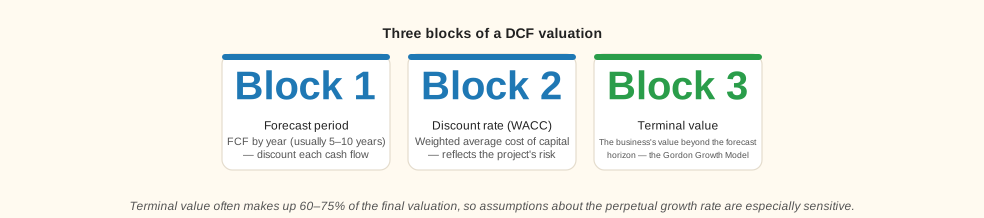
Building a DCF: the three blocks of a valuation
Once the FCF forecast is ready, the main work begins: bringing that future cash back to today's value. That's discounting, using the PV and NPV functions from Unit 4. Each year's cash flow is divided by (1 + rate)^n, where n is the year number. The sum of the discounted cash flows over the forecast period is the first block of the valuation.
The discount rate is “the price of money and risk.” The riskier the business and the higher the alternative return, the higher the rate and the less future cash flows are worth today. In practice, companies are valued using WACC, the Weighted Average Cost of Capital: conceptually, the blended cost of two sources of financing, debt (loans, bonds) and equity (stock). Calculating WACC exactly is a separate topic; here, what matters is that it reflects what investors require.
But the forecast stops at a 5–10-year horizon, while the business (presumably) keeps running. To capture the cash flows beyond the horizon, you calculate the Terminal Value (TV). It's usually most of the final valuation — around 60–75%. So treat the TV assumptions (the perpetual growth rate, the rate) with particular care.
The final formula: Valuation = the sum of the discounted FCFs over the forecast period + the discounted terminal value. In Excel, use NPV for the cash flows and calculate TV separately, then discount it back to period 0 too.