
The learner can explain how an analyst works in an Agile team: helping the product owner maintain and order the backlog, splitting and refining stories, and refining requirements iteratively rather than all up front.
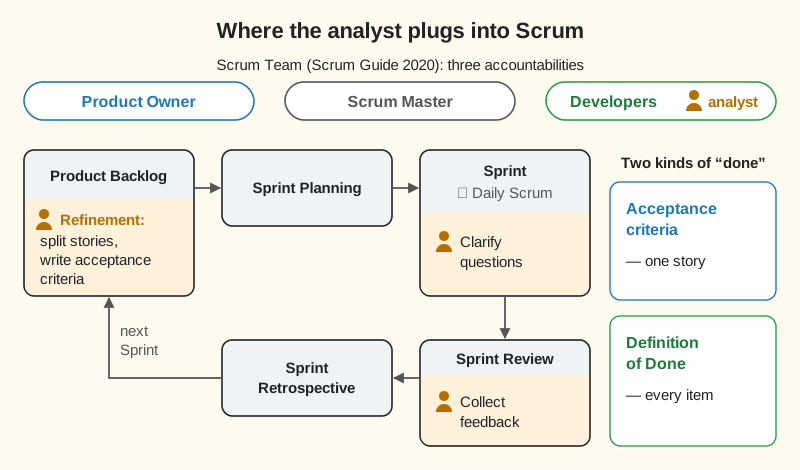
Where the analyst plugs into Scrum
The analyst's touchpoints in a sprint cycle
Scrum has three accountabilities and a fixed cycle; the highlighted points are where an analyst adds the most.
Lesson notes
The analyst's place in Scrum and Kanban
In a traditional waterfall project the analyst wrote a 200-page specification before a single line of code was touched. In an Agile team the approach flips: requirements are refined iteratively, just enough and just in time. The analyst becomes a continuous partner to the product owner rather than a one-time document producer.
The most visible joint activity is Product Backlog refinement (older teams still call it 'grooming'). The Scrum Guide 2020 names three accountabilities: the Product Owner, who owns the product goal and orders the Product Backlog; the Scrum Master, who helps the team use Scrum well; and the Developers — everyone who does the work of the Sprint. Scrum has no separate analyst role: an analyst inside the Scrum Team is one of the Developers and helps the Product Owner make the backlog concrete. Together they break down large, vague epics into user stories small enough to fit in a sprint, write clear acceptance criteria in Given-When-Then format, clarify business rules the team doesn't know yet, and size the work together with the other Developers. A story that enters a sprint planning meeting without acceptance criteria is a liability — the analyst's job is to prevent that.
Two kinds of 'done', two traps, and Kanban
Two different 'done' checks are easy to confuse. Acceptance criteria belong to ONE story and describe its specific behavior, usually in Given-When-Then. The Definition of Done (DoD) is the team's shared quality bar that applies to EVERY item — for example: code reviewed, automated tests passing, documentation updated. An item is finished only when it meets both. The analyst helps make sure the DoD reflects the quality the business actually needs, not just 'it compiles'.
The most common Agile anti-pattern the analyst must resist is 'big requirements up front' (BRUF) — writing a complete specification at the start of a project and then freezing it. In practice, requirements change as the business learns. The analyst's value in Agile is not in eliminating uncertainty early but in managing it continuously: discovering new information each sprint, updating the backlog accordingly, and keeping everyone aligned. Equally harmful is the opposite extreme — starting a sprint with a story that has no acceptance criteria and hoping the team figures it out. Healthy refinement sits between those two traps.
Kanban teams have no sprints: work flows continuously across a board (for example To analyze → Ready → In progress → Done) with a limit on how many items may be in progress at once. There the analyst keeps a small buffer of 'Ready' items — refined, with acceptance criteria — just ahead of the developers, instead of preparing a whole sprint at once.